Incline dumbbell bench press
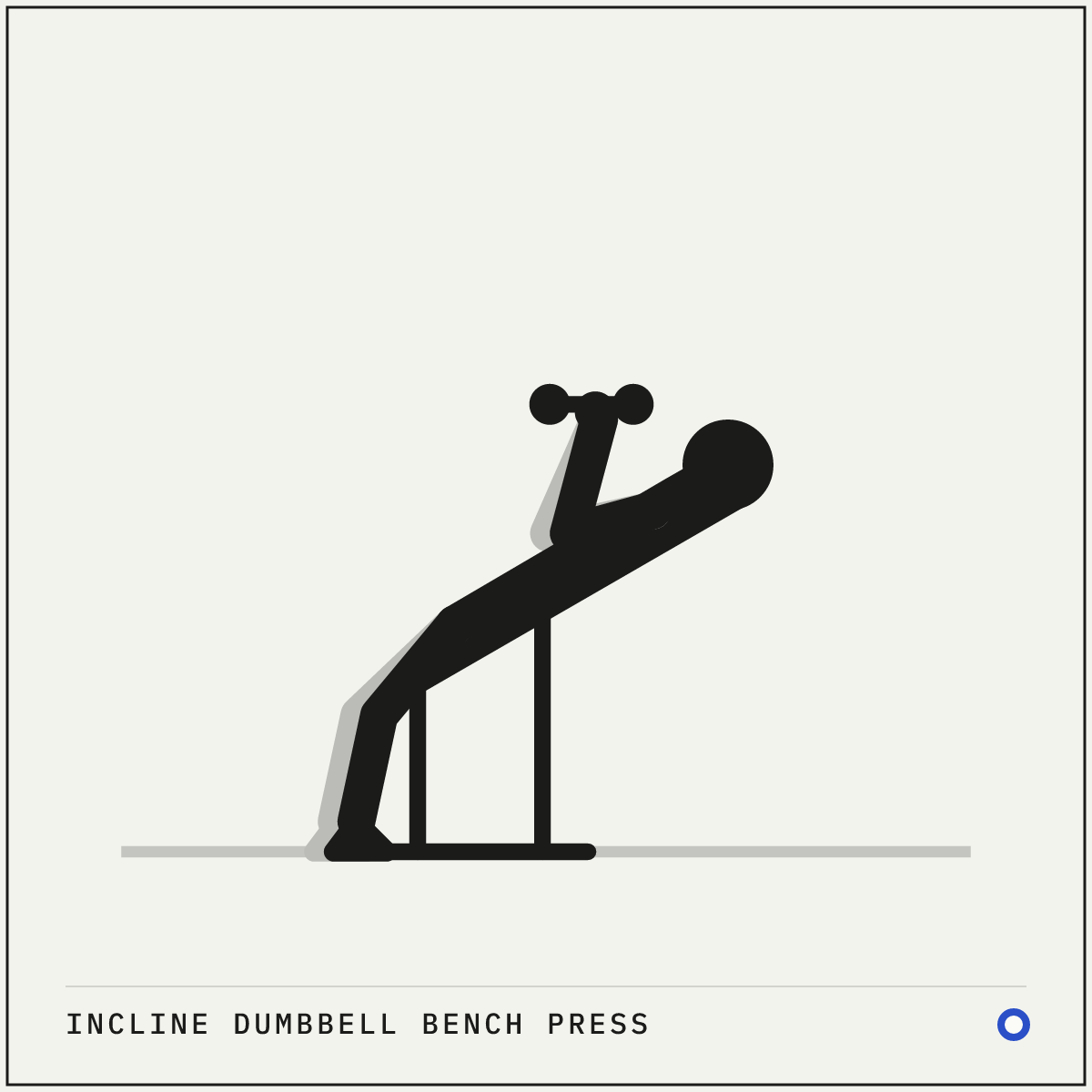
A press from a bench tilted back about 30°, aimed at the upper chest that flat pressing tends to miss.
The movement
2 stages
Weights at the shoulders
01 Weights at the shoulders
Lower until the weights are level with the front of the shoulders, elbows about 45° from the torso.
02 Lockout
Press up over the collarbones until the arms are straight, blades still on the pad.
How to do it
Setup
- Set the bench to about 30° and sit with a dumbbell resting on each knee.
- Kick the weights up one at a time as you lie back against the pad.
- Plant your feet and press your shoulder blades into the bench before the first rep.
Execution
- Press both weights up over your upper chest until your arms are straight.
- Lower under control until the weights are level with the front of your shoulders.
- Press back up along the same line, stopping just short of clashing the dumbbells.
BreathingInhale as the weights come down, exhale as you press.
Cues and mistakes
Check every rep
- Press over your collarbones, not over your face.
- Keep your shoulder blades pinned to the pad all the way to the top.
What goes wrong
- Setting the bench steeper than about 45°, which turns this into a shoulder press.
- Letting the elbows flare level with the shoulders at the bottom, where the joint is least protected.
- Shrugging your shoulders toward your ears to finish the last few reps.
Safety
- Sitting up with heavy dumbbells is the risky part, not the pressing. Bring them to your chest, then rock forward and stand. Never lower them to the floor from straight arms.
General guidance, not medical advice. See how Setkit works.
Notes
The chest is one muscle that pulls in two useful directions. Most of it runs from the breastbone out to the arm, and flat pressing trains that thoroughly. A smaller section runs down from the collarbone, and it only takes a real share of the work when your arm travels up and away from your body instead of straight out from it. Tilting the bench back is the cheapest way to get that angle.
How far to tilt is the whole decision. Around 30° keeps the chest doing the work while adding the upward line. Past about 45° the front of the shoulder takes over and you are doing an awkward shoulder press with a backrest. If your front shoulders are burning and your chest is not, the bench is too steep.
Dumbbells suit this better than the bar. The bottom position is deeper, each arm finds its own path, and you can press the weights slightly together at the top where the muscle actually finishes its pull. The cost is load. Expect meaningfully less than your flat press, and less still for the first few sessions while the balancing work catches up.
One incline session a week alongside flat pressing covers the chest completely. Two is rarely better, and doing only incline work leaves the larger part of the chest short.